In English, the phrases “kill” and “be killed” often confuse learners and even native speakers. While both involve the idea of death or destruction, their usage and meaning are very different. Understanding the distinction is essential, especially in writing, speaking, and professional contexts. Many people misuse these terms, which can lead to misunderstandings or awkward phrasing.
If you want to speak English confidently, write more clearly, and avoid common mistakes, learning the correct use of kill and be killed is a must. By the end of this article, you will clearly know which phrase to use, when to use it, and how to avoid errors in everyday communication.
This guide explores the origin, meaning, and usage of kill vs be killed. You will see examples from movies, TV, news, business, and writing, plus insights into spoken vs written English, British vs American English, and formal vs informal contexts. Whether you are a student, professional, or English enthusiast, this article will help you use these phrases naturally and correctly.
Overview
The phrases kill and be killed are often confused because they both involve the idea of death or destruction, but they serve very different grammatical purposes. Kill is an active verb, meaning the subject performs the action, such as “He kills the spider.” On the other hand, be killed is a passive construction, meaning the subject receives the action, like “The spider was killed by him.” Using the wrong form can make your sentences unclear or grammatically incorrect, so understanding the distinction is essential for both spoken and written English.
In addition to grammar, context plays a major role. Kill is often used in movies, games, and casual conversations, while be killed dominates news reports, formal writing, and serious contexts. Figurative uses also exist, such as “kill time” or “kill the competition,” which can confuse learners if interpreted literally. Knowing when and how to use each phrase will help you communicate more naturally, sound professional, and avoid common mistakes in everyday English.
The Origin of Kill vs. Be Killed
The word kill originates from the Old English term “cwellan,” which meant to murder or destroy. Over time, it evolved in meaning to include not only literal death but also figurative destruction, like “killing time” or “killing a project.” This active form focuses on the subject performing the action and has been widely used in literature, historical texts, and modern media.
On the other hand, the phrase be killed developed as the passive form in English, emphasizing that the subject experiences the action rather than performing it. For example, in reporting accidents or historical events, writers often say, “Several soldiers were killed during the battle.” Both forms share the same root but differ in grammatical structure, focus, and usage, which makes understanding their origin essential for correct and natural English.
Read More: Aunty vs Auntie: Which One Feels Right?
British English vs American English Usage
In British English, the passive form “be killed” is more common, especially in news reports, formal writing, and serious contexts. It emphasizes the subject receiving the action, making statements factual and neutral. For example, newspapers might write, “Three people were killed in the accident,” rather than using the active kill. In casual British speech, kill can appear, but formal writing almost always prefers the passive.
In American English, the active form “kill” is often used in movies, TV shows, games, and casual conversations. Americans tend to favor direct and action-focused sentences, e.g., “The hero kills the villain in the movie.” Formal American English writing still uses be killed for news or academic reporting, but active kill dominates in entertainment and informal contexts.
| Feature | British English | American English |
| Formal Writing | Prefers be killed | Uses be killed, but less strictly |
| Casual Speech | Sometimes uses kill | Frequently uses kill |
| Media & Entertainment | Active kill used sparingly | Active kill widely used in movies/games |
| News Reports | Passive be killed standard | Passive be killed standard, active rare |
Which Context Should You Use It In?
Choosing between kill and be killed depends on who performs the action and the tone of your sentence.
- Use kill when the subject actively does something. This works in casual conversations, storytelling, movies, or games, where the focus is on the actor.
- Use be killed when the subject experiences the action. This is ideal for news, reports, formal writing, or serious storytelling, where the emphasis is on the event or victim.
Example 1:
- Active: “The soldier kills the enemy in the mission.”
- Passive: “The enemy was killed during the mission.”
Tip: Always ask, “Who is doing the action?” If it’s the subject, use kill. If the action happens to the subject, use be killed.
Kill vs. Be Killed – Differences in Spoken vs Written English
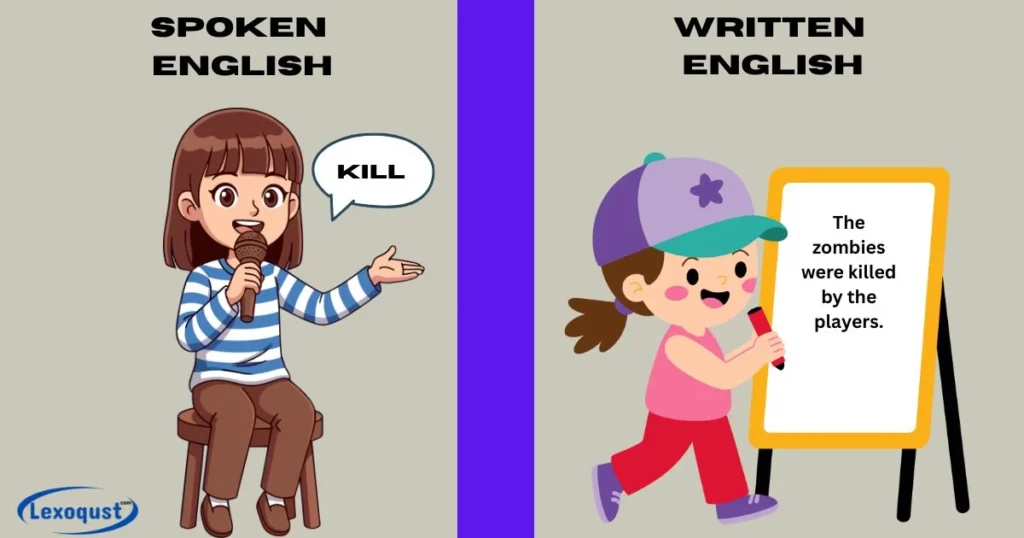
In spoken English, people prefer the active form “kill” because it sounds direct and casual. For example, in everyday conversation or gaming contexts, you might hear: “I killed that boss level!” This usage makes speech lively and expressive, often emphasizing the subject performing the action. Even in storytelling or TV shows, characters frequently use kill to make dialogue energetic and engaging.
In written English, especially in news articles, reports, or formal writing, the passive form “be killed” dominates. It focuses on the event or outcome rather than the doer. For example: “Three workers were killed in the factory accident.” This structure is neutral, factual, and professional, making it suitable for formal contexts. The difference is clear: spoken English favors active and personal style, while written English prefers passive and objective style.
| Context | Preferred Form | Example Sentence |
| Spoken English | Kill (active) | “He kills all the zombies in the game.” |
| Written English | Be killed (passive) | “The zombies were killed by the players.” |
Kill vs. Be Killed – Formal vs Informal Usage
In formal English, especially in news articles, academic writing, or business reports, the passive form “be killed” is preferred. It is neutral and factual, focusing on the event or outcome rather than who performed the action. For example: “Five people were killed in the traffic accident.” This usage avoids sounding harsh or casual and is suitable for professional contexts.
In informal English, including conversations, movies, gaming, or storytelling, the active form “kill” is commonly used. It emphasizes the subject performing the action, making speech or writing dynamic and engaging. For example: “The hero kills the villain in the final scene.” Using kill in casual contexts adds energy and excitement, but it can sound inappropriate in formal writing.
- Formal: “He was killed in the crash.”
- Informal: “He killed the villain in the movie.”
Using kill in professional writing can sound unprofessional or harsh, while be killed is neutral and factual.
Read More: Funny Ways to Say “Happy Holidays” (With Examples)
Kill or Be Killed – Capitalization & Punctuation Tips
Proper capitalization and punctuation help your sentences look professional, clear, and easy to read. With phrases like kill and be killed, it’s important to follow standard rules to avoid confusion.
Capitalization Tips
- Start of a sentence: Always capitalize the first word.
- Correct: “Kill or be killed in the game.”
- Incorrect: “kill or be killed in the game.”
- Correct: “Kill or be killed in the game.”
- Titles & Headings: Use title case for blog posts, articles, or headings.
- Correct: “Kill or Be Killed – Correct Examples“
- Incorrect: “kill or be killed – correct examples”
- Correct: “Kill or Be Killed – Correct Examples“
- Within a sentence: Only capitalize proper nouns; the phrase itself stays lowercase unless it begins a sentence.
- Example: “He knows the rule: you kill or be killed.”
Punctuation Tips
- Hyphens and Dashes: Use a dash for emphasis in headings.
- Example: “Kill or Be Killed – Formal vs Informal Usage”
- Example: “Kill or Be Killed – Formal vs Informal Usage”
- Commas: Use commas to separate clauses when needed.
- Example: “In the movie, the hero kills the villain, and the audience cheers.”
- Example: “In the movie, the hero kills the villain, and the audience cheers.”
- Exclamation Marks: Use sparingly to show excitement, mainly in informal contexts.
- Example: “He kills the dragon!” ✅
- Formal writing avoids: “He kills the dragon!” ❌
- Example: “He kills the dragon!” ✅
Read More: Other ways to say “Please Let Me Know If This Works For You”
Kill vs. Be Killed in Everyday Examples
Movies & TV
- Active: “The hero kills the villain in the climax.”
- Passive: “The villain is killed during the final battle.”
News
- Active: “Police killed the suspect in a shootout.”
- Passive: “The suspect was killed during a police operation.”
Business
- Active (metaphorical): “This startup killed the competition.”
- Passive (rare, formal report): “The previous strategy was killed by market changes.”
Writing
- Active: “She killed the essay competition with her idea.”
- Passive: “The essay was killed due to plagiarism.”
Kill vs. Be Killed – Popularity & Usage Trends
Search data and media show that kill appears more in entertainment and casual content, while be killed dominates in formal writing, news, and historical texts. Writers should choose based on tone, audience, and medium.
Kill vs. Be Killed – Meaning Comparison
| Phrase | Meaning | Usage Example |
| Kill | Subject performs the action | “He kills the dragon in the game.” |
| Be killed | Subject receives the action | “The dragon was killed by the knight.” |
Kill vs. Be Killed: Correct Grammar
- Kill is transitive and requires an object: “She killed the mosquito.”
- Be killed is passive and needs a past participle: “The mosquito was killed by her.”
Clear Explanation of the Meaning
“Kill”
- Active form
- Subject performs the action
- Literal: “He kills a snake.”
- Figurative: “The singer killed the performance.”
“Be killed”
- Passive form
- Subject receives the action
- Literal: “The snake was killed by him.”
- Figurative (rare): “The project was killed by management.”
Read More: Other Ways to Say “I Hope You Had a Great Weekend”
Common Mistakes People Make
1: Using It for Small Problems
- “I killed my homework” → Incorrect
- “I finished my homework” → Correct
2: Thinking It Always Means Real Death
- “He killed the presentation” → Figurative, correct
- “She was killed in the presentation” → Incorrect figurative use
3: Using It in Formal Emails
- “I killed the budget report” → Incorrect
- “I completed the budget report” → Correct
4: Changing the Structure
- “The man be killed the thief” → Incorrect
- “The thief was killed by the man” → Correct
Kill or Be Killed Philosophy
In literature and games, kill or be killed represents a survival mindset: act first or face consequences. It’s a strategic and moral concept, often discussed in war, gaming, and competition scenarios.
Example:
- “In the survival game, you must kill or be killed to advance.”
- “Business competition often feels like kill or be killed.”
- “Historical battles often followed a kill or be killed logic.”
Read More: Funny Ways to Say “Someone Is Gay”
Kill or Be Killed – Correct Examples
Using kill and be killed correctly depends on whether the subject performs the action or receives it. Choosing the right form ensures your sentence is grammatically correct and easy to understand.
Active (Kill):
- “The warrior kills his enemies in the battle.”
Here, the warrior performs the action, so kill is correct.
Passive (Be Killed):
- “His enemies were killed by the warrior.”
In this sentence, the enemies receive the action, so the passive form “be killed” is used.
Incorrect vs Correct:
- ❌ Incorrect: “His enemies be killed by the warrior.”
- ✅ Correct: “His enemies were killed by the warrior.”
Figurative Use:
- Active: “She killed the presentation with confidence.”
- Passive (rare, formal): “The outdated project was killed by management decisions.”
Everyday Scenario:
- Active: “He kills the spiders in the garden every week.”
- Passive: “The spiders are killed by him every week.”
Using these examples, you can confidently decide which form to use in spoken, written, formal, or informal English. The rule is simple: if the subject acts, use kill; if the subject is acted upon, use be killed.
Key Insight
1. Can I use “kill” for small problems?
No. Kill implies total destruction. Use words like fix, solve, or complete for minor issues.
2. Is “be killed” always formal?
Mostly yes. Use it in news, reports, or serious writing.
3. Can “kill” be metaphorical?
Absolutely. “She killed the dance performance” is figurative.
4. Which is British English vs American English?
British English prefers to be killed in formal contexts. American English uses kill casually in speech and entertainment.
5. How do I avoid mistakes with these phrases?
Focus on who does the action. Use kill for active subjects and be killed for passive situations.
Wrap-Up
Understanding kill vs be killed is crucial for clear communication. Kill is active, showing the subject performs the action, while be killed is passive, indicating the subject receives it. Both forms have literal and figurative uses, appear in movies, news, business, and writing, and vary in formal and informal contexts.
Avoid common mistakes like using kill for minor problems or mixing active and passive incorrectly. Remember, your choice depends on context, audience, and tone. Mastering these phrases improves your spoken and written English, making you sound confident and natural in any situation.

Hi! I’m Amelia Ashford, the admin of Lexoqust.com. Here, we dive deep into the world of synonyms to help you express yourself better.From everyday words to advanced vocabulary, Lexoqust makes your writing richer and more refined.